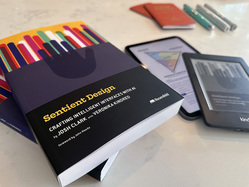
Our new book is out today. We wrote it because we needed it. We’re sharing it because we think you might need it, too.
Sentient Design is our answer to what’s next for design (and designers): Embrace AI as a design material for extraordinary new experiences, not just a tool to wring savings or grind out efficiencies.
Sentient Design is the practice of creating intelligent interfaces. These are experiences with the awareness and agency to respond to your users in the moment: dashboards that design themselves, intelligent canvases that bloom with data visualizations, AI that participates in apps like any other user, and so much more. This goes way beyond text-based chat and agents.
You can make things now that weren’t possible before. Designers have been talking about creating adaptive and personalized interfaces for decades. Now you have the technology to do that and more, enhancing traditional experiences and inventing meaningful new ones.
Sentient Design shows you how to do it. You can buy the book today from your favorite bookseller or directly from our publisher, Rosenfeld Media. (Thank you for supporting books and ideas, reader; it means a lot. If you enjoy the book, we hope you’ll share it with your team or post a review.)
Whoa, wait, what?
Remember the first time that AI surprised you with what it could do? That whoa, wait, what feeling? This book sprang from a moment like that. For us, it was when we saw a web app dance … like really dance.
We were tinkering with a weekend project to build a web app that could act out scenes. We told it to be “a graceful ballet dancer,” and a little glowing square began to glide and pirouette across the screen.
We told it to rocket to Mars, and the square turned red and zoomed back and forth across the top of the window. We asked the app to play dozens of different roles—underwater adventurer, inept wizard, cartoon puppy—and it obliged every time. None of this was explicitly coded. We never taught it to dance or drive a submarine. The system took our cues and reshaped its behavior to act out the scenario.

As daughter and stepdad, we get together for lots of side-quest projects like this. But this one cracked something open. For a little toy, it felt much bigger.
This was something new: an interface that took any request and adapted its entire form in response. The system riffed with us, as users, to create experiences we had neither designed nor anticipated. We called it Sentient Scenes.
Once we saw the possibility, we couldn’t unsee it: intelligent interfaces that adapt themselves to the moment. What if any interface could be this adaptive and aware? What if a website could redesign itself to fit the moment by wiring interface to intent? What if the idea of a website was itself too limiting? What happens when the interface escapes the screen?
Your New Design Material
Discovering this new kind of intelligent interface was both a thrill and a relief. A creeping anxiety about what AI would do to design gave way to real excitement about what designers could do with AI. By weaving intelligence into the interface, we realized AI could elevate design rather than replace it.
We adopted AI as a material, not just a productivity tool. It became part of the very fabric of the interfaces we create. We began working this material into all of our work at Big Medium. In products spanning finance, healthcare, publishing, and more, we’ve made interfaces come to life in ways that have only just become possible.
We’re not the only ones. Intelligent interfaces are emerging everywhere—digital whiteboards that turn sketches into applications, customer service agents that handle routine issues on their own, assistants that generate medical reports from a doctor’s spoken notes. The more we looked, the more we found other forward-looking teams pushing the possibilities.
This exploration has rippled across enterprise and startup alike, but the approach has been haphazard. There has been no map for this new territory, no uniform vocabulary, no framework for choosing what type of intelligent interface to create—or even what those types might be.
So, we started mapping. We identified and named new kinds of intelligent interfaces and organized their design patterns. Along the way, we discovered a broad expanse of experiences that go far beyond chatbot clichés. What began with a study of form led to something deeper: a new design practice.
Sentient Design gives designers and product leaders the knowledge and intuition to create these new experiences. This is not a book about tooling or about replacing design tasks with AI. Nor is it a technical tome about the latest models or prompting tips. Our aim is to give you the perspective and principles to imagine and deliver powerful new products.
Literacy, Map, and Practice
This book gives you literacy in machine intelligence as a design material—what it’s made of, what it’s good at, where it fails. It provides the map, a framework that navigates 14 experience patterns you can use today. And it delivers the practice: how to manage risks, how to move from imagination to implementation, and how roles must evolve.
As a designer, you’ll learn more than just techniques and patterns. You’ll evolve from crafting static interfaces to directing systems that make design decisions in real time. Sentient Design changes your work—and for the better—by rewarding creativity, systems thinking, and collaboration.
But that doesn’t mean you’re starting from scratch; Sentient Design also builds on familiar principles from user experience and product design. Our work stands on the shoulders of giants, and we’re fortunate and grateful for the support of so many who have defined our craft. Big thanks to John Maeda for contributing his generous foreword and to our many advance readers for their valuable feedback. It’s thrilling and terrifying to put a book into the world, so it’s also dizzying (in the best way) that the people we love, fear, and admire lent their names and endorsements.
Challenging and Powerful
We learned Sentient Design the hard way. The work has been fun and frustrating, enlightening and perplexing. AI constantly surprises us with how spectacularly it succeeds or fails. We’ve seen the sparkles fizzle as often as they dazzle.
The approach requires optimism but also acknowledgment that the technology itself is fraught. It threatens deep environmental, social, and creative costs. It raises urgent questions about copyright, labor, and what it means to make things. The cynical deployment of AI extracts efficiencies at human expense.
These threats are real, but they’re not inevitable; many of these harms are driven by business decisions, not inherent aspects of the technology. Modern AI models can be built and used without exploitation. The good and bad of this technology will be determined in part by people like you, the folks who design how AI is used.
The book devotes considerable attention to responsible approaches that anticipate and soften AI’s risks. We hope you embrace those strategies. This consequential work needs all of us, from a range of perspectives.
Two Generations of Design
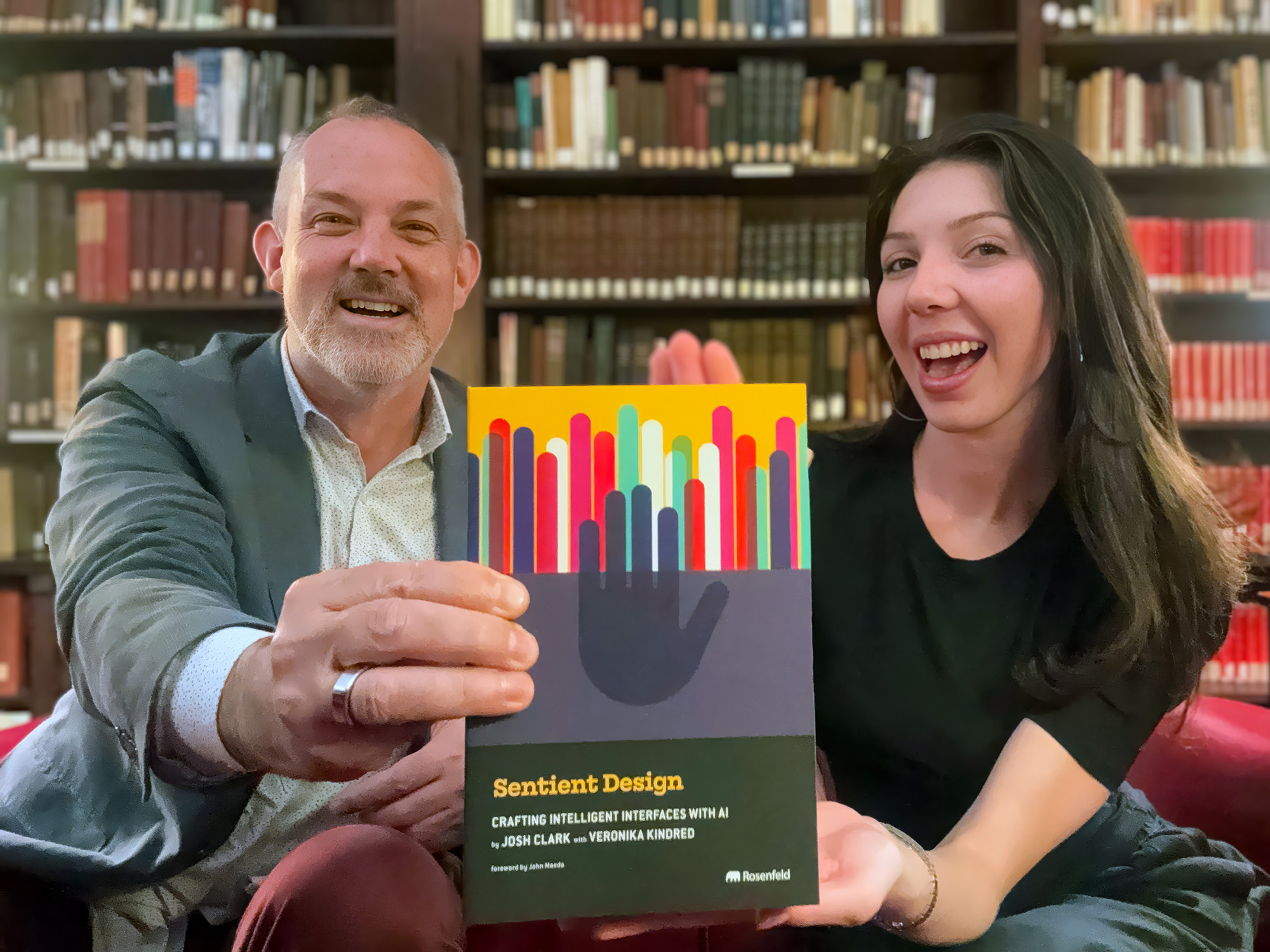
We developed Sentient Design by bringing together two generational views of the craft. Josh has spent 30 years designing for consistency and predictability, the hallmarks of “good UX.” Veronika meanwhile started her career just six months after ChatGPT launched, and she grew up in a world of constantly shifting algorithmic feeds.
Veronika may not have Josh’s experience, but she’s also not burdened by it. While Josh saw Sentient Scenes as breaking the mold, Veronika saw it doing what interfaces should have been doing all along. Neither of us would have built Sentient Scenes alone—or written this book alone, either.
We are also two generations in a more literal sense. Writing this book as a dad-daughter combo makes the stakes higher, more personal. The decisions designers make today will have profound effects on Veronika’s generation and those that follow.
So, we wrote this book not only for you, but for our family and yours. Together we’re shaping the future. Let’s make it dance. You can learn the steps here.