“How do we transition our thinking, not for one deeply thoughtful flow or feature, but for a whole system where agents can build things we’ve never seen?”
In his essay The Mental-Model Reset: Designing Systems That Decide, Aaron Sagray explores what it means to design intelligent interfaces at scale. The VP of design at Mural describes his own team’s shift and concludes that more than learning new tactics or design patterns, the next era of design requires a fundamental shift in perspective.
When an agent is composing the output itself, deciding at runtime what an analysis should look like for this user with this data, there is no screen to show. There’s a range of screens. A distribution of screens. … When the interface is assembled at runtime, designers need to shift to outcome-oriented design, defining the goals, constraints, and rules the generation must operate within, rather than the discrete elements themselves. …
Less playwright, more improv director. A playwright writes every line and the actors deliver it verbatim, eight shows a week, identical. An improv director never scripts a line; she designs the scene: who’s on stage, what they know, what the rules of the game are, what’s out of bounds. Then the performance happens, differently, every single night.
This change hurts the brain at first and sometimes offends professional instincts about what control and quality mean for design. Adapting requires unwinding some closely held assumptions about best practices or even what the craft is at its core. Aaron offers a list of 10 instincts to unlearn and proposes their replacements. On the “tired” list: “the screen I ship is the screen the user sees,” “same input, same output,” and “edge cases are rare states we document at the end.”
These are assumptions “held by your best people most firmly, because their careers were built on being right about them,” Aaron writes. “Treat the unlearning with respect or it won’t happen.” He offers an exercise to help limber up a design team around the implications and realities of radically adaptive interfaces.
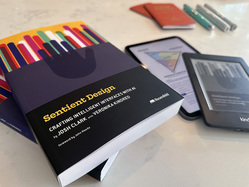
Aaron draws on the good work of Maggie Appleton, Christopher Noessel, and Jakob Nielsen to explain the arc of this shift. And he shares some kind words about our book Sentient Design, too, calling it the best resource for embracing this transition: “The richest treatment of AI as a design material and radically adaptive interfaces. This is the book I’m recommending for this moment.”