“If machines are great at the things we’ve long thought to be uniquely human, maybe we’ve been misunderstanding humanity all along.”
This weekend I picked up a physical copy of The Humanist Review of AI at Casa Magazines, a collection of essays on AI by technologists, academics, and philosophers compiled by Mustafa Suleyman, the head of Microsoft AI. Audrey Tang’s essay, AI and democracy: the right to resist optimization, stood out for the way it reframes a conversation that’s become a little bleak.
The reassurance we keep hearing goes something like this: Sure, LLMs can write songs and novels and will probably make movies soon, but don’t worry—humans will always have taste. It’s a pretentious consolation, and probably not even true. A probabilistic system armed with design principles can make evaluations of taste just fine.
For better and worse, humans are no longer unique for having ideas or for writing them down. What remains unique is our ability to stand behind our creations—to be accountable for them and to love them. People flock to IMAX theaters not out of love for the film format, but because a director like Christopher Nolan made a stand for it. It’s the person behind a creation that gives it meaning; the audience trusts him.
Tang, like our own Josh Clark, argues that Turing’s imitation game has been a trap from the start. We shouldn’t build machines to imitate us—and we shouldn’t evaluate ourselves like machines either. She points to social media, where content is ranked by engagement, as a case of humans optimizing themselves against a machine’s metric. It’s hard not to think of education, where standardized tests reward answering questions on short passages, so classrooms assign excerpts instead of books—and students stop reading books at all. We keep building the very world we say we’re afraid of.
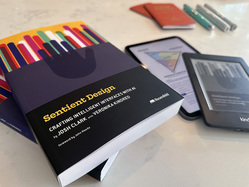
So what should we be cultivating instead? Tang offers a starting place, naming the skills she sees as essential for the future: originality, expression (getting your ideas across to other people), and morals. It pairs well with the argument we make in the first chapter of Sentient Design—that there have always been many kinds of intelligence, and the arrival of machine intelligence should sharpen rather than diminish our sense of the human ones.
“What ways of becoming human should education cultivate when many forms of performance can be automated?” My answer is that education must move away from ranking compliant output and toward cultivating interpretive courage, collaborative range, ethical imagination and the capacity to participate in revision without losing face.