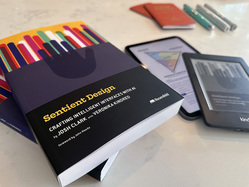
Usability legend Jakob Nielsen offers a thorough review of Sentient Design (plus a detailed comic-strip summary!). His conclusion: “Buy the book already.”
Jakob’s review focuses especially on bespoke UI, one of Sentient Design’s 14 experience patterns. There are many types of intelligent interfaces, but bespoke UI is among the most radically adaptive, assembling GUI interfaces on the fly. When handled well, it provides just the right interface for the moment. When handled poorly, it can be confusing and disorienting, a robot fever dream. As Jakob calls out, this is an experience that requires fresh technique and perspective for designers.
The role of the designer transforms from placing pixels to acting as a creative director for a system that designs its own moment-to-moment experiences. …
The vision also sharpens a tension the field has barely begun to address: bespoke, ephemeral interfaces collide with consistency, the property that lets users transfer skills between products (Jakob’s Law) and lets one user help another. And if every screen is generated fresh, you can no longer usability-test “the design,” because that exact design will never exist again. Evaluation must move up a level: we will test the component library, the constraints, and the generation rules rather than individual screens. QA the factory, not every widget it produces. That shift, too, is part of the creative-director role Clark and Kindred describe.