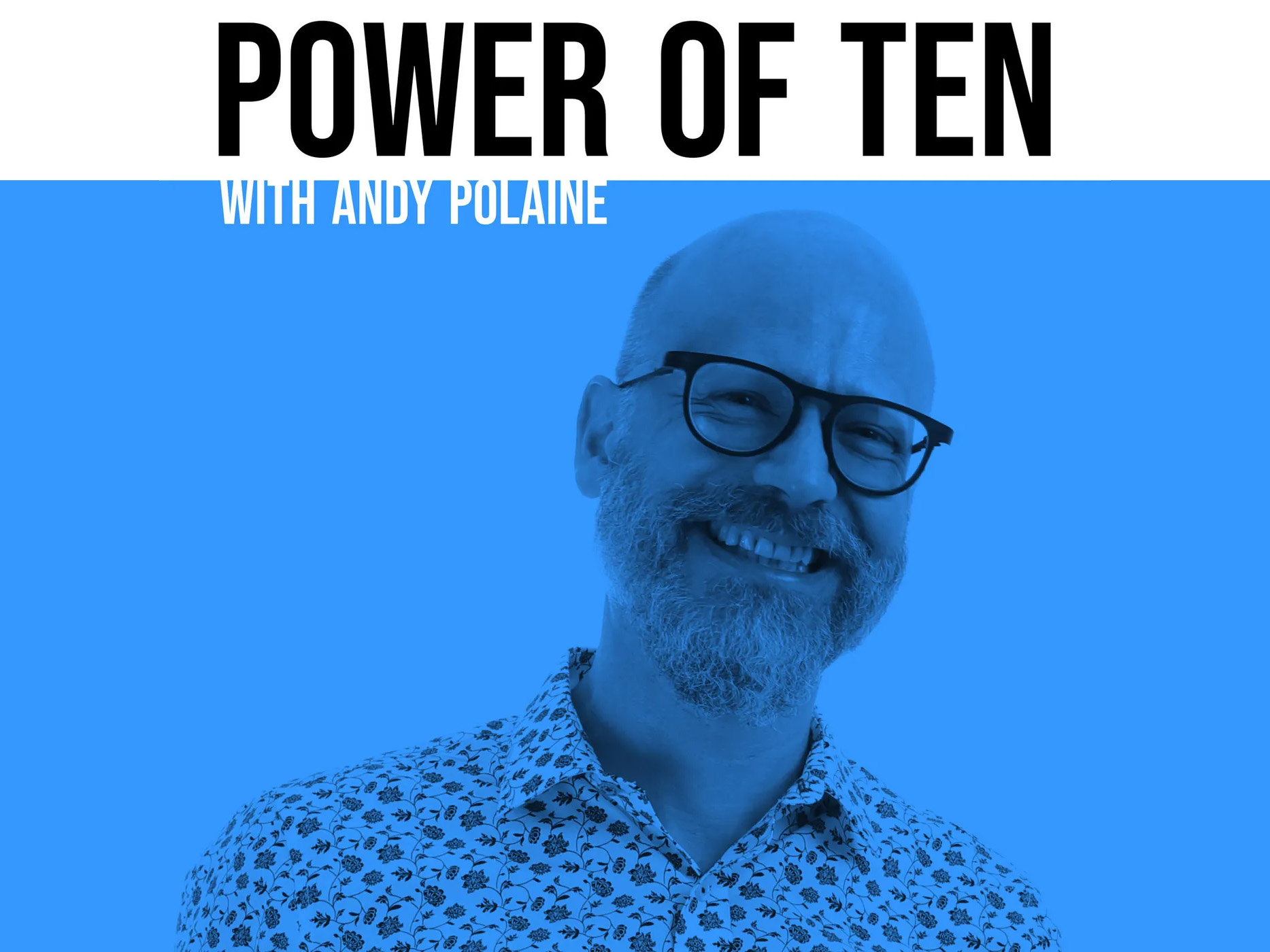
Is design ready to put aside its fascination with process and operations and return to actual product invention? Big Medium’s Josh Clark and Veronika Kindred joined service design legend Andy Polaine on the Power of Ten podcast for a conversation that roams from Zork to world models, landing on why Sentient Design finally returns design to the business of exploring a new medium.
The design industry has spent the last decade perfecting design at scale as big companies brought design in-house. This was important work but had an unintended consequence: design was reduced to a production function for cranking out conveyor-belt UI, rather than deeper invention.
Veronika and Josh argue that AI lets us create meaningful new experiences that weren’t possible before, if product leaders and designers are willing to seize the opportunity. We’re confronting the first paradigm shift since mobile came along 15 years ago, yet many designers seem more focused on using AI to do the same stuff faster. Josh and Veronika describe a better way.
What they got into
- Why the last 10–15 years of design innovation went almost entirely to design ops and design systems, and why that’s changing now.
- Ephemeral experiences that invent the world as you explore it.
- The Sentient Triangle and its four postures—tools, chat, agents, and copilots—each defined by the stance the system takes toward the user.
- How LLMs suddenly solved the wicked problem of user intent.
- Hallucinations as a feature not a bug, and how to design accordingly.
- Dolphins, chameleons, and mushrooms: alternate models of intelligence that don’t have to “act human” to be effective.
- Practical magic and the minimum magical product.
- Why clients who ask for “industry leading” usually mean industry standard (and why risk is overvalued in tech culture).
- The spectrum of adaptive interfaces from the casual interface of smart form defaults to radically adaptive experiences invented on the fly.
Quotable
Veronika: “There’s been so much focus on efficiency and process in bringing AI into people’s work, which is not particularly creative. It’s a very engineering-focused view, a very input-and-output scenario. Our book is about the new kinds of experiences people can create, the new kinds of products that are possible.”
Josh: “When we keep trying to fit this technology into a hole that looks like what came before, deterministic systems, we’re frustrated. But [LLMs] were never built to do that.”
Josh: “Systems can now understand anything I say and the meaning behind it. That is computing magic. It’s kind of amazing how quickly we’ve begun to take that for granted, but it’s something we’ve been pursuing for decades, and suddenly it became possible.”
Veronika: “Experiences can take on style and mood and tone and personality without pretending to be human. You would never look at a moody browser and infer friendship.”
Josh: “Intelligent interfaces don’t have to be talking interfaces.”
Veronika: “I don’t necessarily have trust in the people or companies driving these technologies, and so it’s really important to pay close attention and stay engaged. Now is a great opportunity to have a ton of influence over how this technology is implemented in our lives — especially as designers. Getting involved right now will have a lasting impact for a long time in the digital world.”
Josh: “Large organizations are designed to reduce risk and increase predictability, which means reducing innovation.”