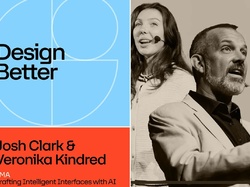
The qualities that made design systems successful in the last decade won’t be what carries them into the next. Big Medium’s Josh Clark and Veronika Kindred joined the ever-curious Ben Callahan and his community of design system practitioners on The Question to explore what Sentient Design asks of design systems, and the exciting opportunity it opens for the teams who build them.
“The precise future is uncertain,” Josh said, “but I think that there is a rich, rich future for designers and design systems. It is going to look really different from the last decade. … We have an opportunity to elevate our work.”
As intelligent interfaces define the next generation of product design, Josh and Veronika argue that design systems have to move beyond GUI components to embrace behavior, capability, and interaction. Product teams are already shipping AI-powered experiences that design systems aren’t equipped to support, and Josh and Veronika urged design system teams to look up from their component libraries and token sets.
“I always walk away from conversations with you both with a positive outlook on the future,” Ben said, “when a lot of folks are preaching doom and gloom.”
Not a typical podcast
The Question has a format all its own. Ben sends a survey to The Question community ahead of time, then crunches the answers and builds a FigJam board to illustrate the themes, then hosts a live, collaborative deep dive to explore what emerged, followed by a recap conversation.
What they got into
- “AI-ready” is not really AI-ready: To many, getting design systems ready for AI means using it to manage tokens, generate components, or build layouts. While useful, that’s also just doing the last decade’s job faster. The real opportunity is enabling entirely new experiences and intelligent interfaces.
- The widening gap between product and design system: As products move to support chat, agent, and copilot postures, a design system that stops at components and tokens covers less and less of what actually ships.
- Bespoke UI (or generative UI) is the gateway drug: Assembling components is the most basic kind of design. Intelligent interfaces can go much farther: NPCs that work alongside people in their own account, intelligent canvases that propose and blend content, and interfaces that change modes entirely.
- Diving below the surface: Design systems have to reach deeper than surface UI widgets. Systems should frame and define the behaviors of intelligent interfaces that can choose actions and interaction paradigms on the fly. Those are the important design decisions to support now.
- Behaviors are the new application building blocks: How to manipulate the objects in the system, the actions that can be taken on them, and when an agent should step forward. Design systems need to define the consistent conventions for these.
- Where behavior and components meet: From the casual intelligence of fields that pick their own default values to fully emergent UI.
- Design system teams have to step up (and step forward): If design system teams stay in the background, product teams and AI engineers will define behavior as one-offs, the kind of fragmentation design systems were invented to solve. Design system teams typically play a support role, but their system thinking is needed, with active collaboration in product decisions.
- Naming things matters more than ever: The language around AI is muddled, causing unnecessary friction. Design system teams can help untangle it. Sentient Design provides crisp organization and vocabulary for new patterns and experiences.
- The missing artifact: What do behavior artifacts look like? Skills point in the right direction, but they feel like an engineering format, hostile to many. What’s the format for behavior that every discipline can work in?
- GUI won’t go away, but it’s also not enough: Even as agents do the work, we need user experience (and manager experience) more than ever. Interaction modes multiply.
- Plus: AI knockoffs of your design system, armies of one, a teacher who makes students build each other’s specs, and déjà vu from the responsive design era.
Quotable
Josh: The innovation in design systems is no longer building and distributing GUI components. “The fundamental practice for GUI [design systems] is settled … The innovation is now how do we use those systems to create these intelligent interfaces that are radically adaptive and created on the fly.”
Josh: Even the frontier labs are still figuring this out, so don’t feel panic that you’re missing out. “If everybody’s behind, nobody is.”
Veronika: “There’s this renewed respect for the systems thinking … As designers, our capabilities are becoming less about pixels and more about really designing the physics of the universe in which the design is happening.”
Josh: Using AI to assemble components in custom layouts is step one, not the end point. “[That’s] what we think of as the gateway experience to Sentient Design … We call that bespoke UI, and that’s a great place to begin … But we also have a broader set of on-the-fly experiences.”
Josh: “The new layer … is the behavioral layer. What are the objects in the system and the actions that can be taken on them? And [how] does the agent know what to do, when to come forward, and what is its decision-making around those things?”
Josh: “An opportunity and challenge for design systems is: how do we provide some glue? So that people are working within the same systems and guidelines, not only for components and brand tokens, but for the behavior and manner of these systems.”
Veronika: “How do we work together if we don’t know what we’re talking about? If we’re using ten words to talk about the same thing, or if we’re using the same word, ‘agent,’ to talk about really different things? There’s definitely a need for specificity and precision right now.”
Veronika: “When we go and talk at companies with big design teams, I watch a team change from the beginning of the day to the end of the day, now that they can all use the same language to talk about things.”
Josh: “There’s a lot of pressure right now toward productivity and efficiency … doing the same crap we’ve always done but faster, and that doesn’t sound fun for anybody. We have a new creative opportunity, though: When we think of [AI] as a design material, we can make stuff that wasn’t possible before.”
Josh: “We’re in a moment where we are inventing new experiences, new interaction patterns, new artifacts, new kinds of design process. That is a lot for any one team to say, ‘Here’s how it works. We figured it out.’ At the same time … this is not a time for anyone to stay in their lane. More than ever, we need multiple disciplines to figure out what intelligent interfaces look like.”
Josh: “The folks making the products don’t know the answers and are looking for help. One of the things that design systems folks can do is help them to organize their thoughts. What are design systems folks good at? Systems thinking.”
Tune in
- Watch on YouTube: deep dive · recap
- Listen to the podcast: deep dive · recap
- Explore the survey data and the FigJam board
- Subscribe to The Question